The Hermetic Laws & Quantum Physics: Where Ancient Wisdom Meets Modern Science
Expanded Course Framework
I. Course Vision & Philosophy
This course investigates one of the most provocative questions at the intersection of science and spirituality: Did the ancient Hermeticists encode knowledge about the fundamental nature of reality that modern physics is only now rediscovering?
This is not a course in superficial analogies or cherry-picked parallels. It is a rigorous, intellectually honest, and deeply researched exploration of the seven Hermetic principles alongside the most profound discoveries of quantum mechanics, relativity, information theory, and cosmology, examining where the correspondences are genuine, where they are merely metaphorical, where they break down entirely, and what all of this reveals about the nature of reality itself.
The course serves two populations simultaneously: those grounded in science who sense that something deeper is going on, and those grounded in esoteric traditions who want to understand the actual physics rather than pop-science distortions. Both groups will be challenged. Both will be enriched.
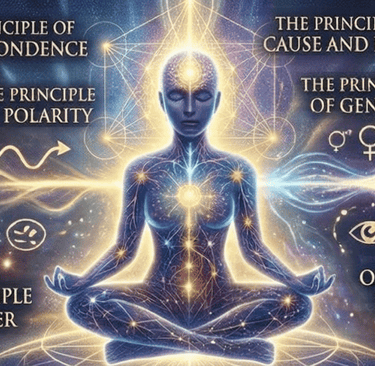
The seven Hermetic principles; Mentalism, Correspondence, Vibration, Polarity, Rhythm, Cause & Effect, and Gender, were codified in the Kybalion (1908) but trace their lineage through the Corpus Hermeticum, medieval alchemy, Renaissance magic, and ultimately to the legendary figure of Hermes Trismegistus. As the Kybalion itself states: "The Principles of Truth are Seven; he who knows these, understandingly, possesses the Magic Key before whose touch all the Doors of the Temple fly open."
We employ a Backward Design approach. Beginning with desired learning outcomes and building assessments and experiences to achieve them, combined with active, inquiry-based learning where students function as investigators, not passive recipients of information.
"The lips of wisdom are closed, except to the ears of understanding."
— The Kybalion
"Anyone who is not shocked by quantum theory has not understood it."
— Niels Bohr
Prerequisites: No formal science or philosophy background required. The course teaches all necessary physics concepts from the ground up using accessible language, visual demonstrations, and experiential analogies. Mathematical expressions are presented conceptually with optional deep-dive supplements for those who want the equations. What is required: intellectual honesty, tolerance for ambiguity, and willingness to hold multiple frameworks simultaneously without collapsing prematurely into certainty.
Course-Level Learning Outcomes
Upon completion of this course, students will be able to:
Articulate the seven Hermetic principles with historical and philosophical accuracy, tracing their lineage from Egyptian and Greek sources through the Corpus Hermeticum, medieval alchemy, Renaissance magic, and the 1908 Kybalion
Explain the core concepts of quantum mechanics, relativity, thermodynamics, information theory, and cosmology at a conceptual level sufficient for meaningful philosophical analysis
Analyze proposed correspondences between Hermetic principles and modern physics using the three-level framework (isomorphism, analogy, false correspondence), providing evidence-based arguments for their classifications
Evaluate popular claims about "quantum spirituality" and distinguish legitimate philosophical implications of physics from pseudoscientific appropriation
Synthesize insights from both traditions to articulate a personal philosophical framework regarding the nature of reality, consciousness, and their relationship
Demonstrate critical thinking about the limits of both scientific materialism and esoteric traditionalism as complete accounts of reality
Apply Hermetic-scientific correspondences as practical tools for understanding and navigating personal and collective transformation
Create an original work (essay, visual presentation, or course module) that communicates one Hermetic-physics correspondence to a general audience with intellectual integrity
Course Structure: 16-Module Curriculum
The course is organized into four parts:
Part I (Modules 0–1): Foundations - historical and scientific groundwork
Part II (Modules 2–8): The Seven Principles - one module per Hermetic law, each paired with its physics counterpart
Part III (Modules 9–11): Advanced Synthesis - where the parallels converge into larger frameworks
Part IV (Modules 12–13): Integration - discernment, application, and capstone
This incredible course is now available! Click on the button below to start a free preview for an amazing journey into the most important questions anyone could explore.
James

Connect
Join our community for insights and updates
Contact
Support
contact@thegreatworkplatform.com
© 2025. All rights reserved.
support@thegreatworkplatform.com